Find Your Nearest Timken Sales Office or Authorized Distributor

Our locator tool helps you connect with the right Timken partner quickly. Registered users
can save their nearest Timken Sales office or distributor in their dashboard.

Analyze Bearing Performance in an Application with Timken ® Syber ® Bearing System Designer

A powerful software tool that combines calculators and configurators to assist you with application design, bearing selection, installation, and troubleshooting. It’s free, easy-to-use, and accessible 24/7.

Learn More
Explore Timken Engineering Tools
Videos on YouTube

Check out our Engineering Tools video playlist on YouTube. These short walkthroughs
help you navigate Timken calculation tools, selection guides and digital resources.

Batch CAD Cart (0)
  • Cart is empty
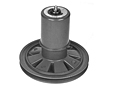
  • Model 145 Spring-Loaded Driver Pulleys - Imperial

    Two-Side Moveable
    1/3 through 1-1/2 HP
    “A” and “B” Belts

        Aluminoline variable speed pulleys are designed for the best possible belt alignment with the least amount of overhung load. Flanges are made of a lightweight, corrosion-resistant aluminum, which is hard-coat anodized for long life. The aluminum flanges provide quiet operation with minimum vibration. These pulleys are used with classical “A” and “B” drive belts. Aluminoline pulleys offer maximum service when lubricated through a convenient grease fitting located on the end of the pulley shaft.

      Belt Selection
        Aluminoline variable speed pulleys are designed to drive standard “A” and “B” section belts. Due to the intermeshing flange design, it is best to use a wrapped belt or one without cogs.

      Adjustable Center Drives
        The typical adjustable center drive consists of the Aluminoline pulley mounted on the motor shaft, a companion sheave on the driven shaft, an adjustable motor base and a belt. Standard “A” and “B” fixed diameter sheaves should be used as driven companion sheaves. Belt alignment will be maintained throughout the speed range because the Aluminoline pulleys are two-side moveable. Due to the minimal bottom contact area of “A” and “B” belts, flat driven sheaves are NOT recommended.